
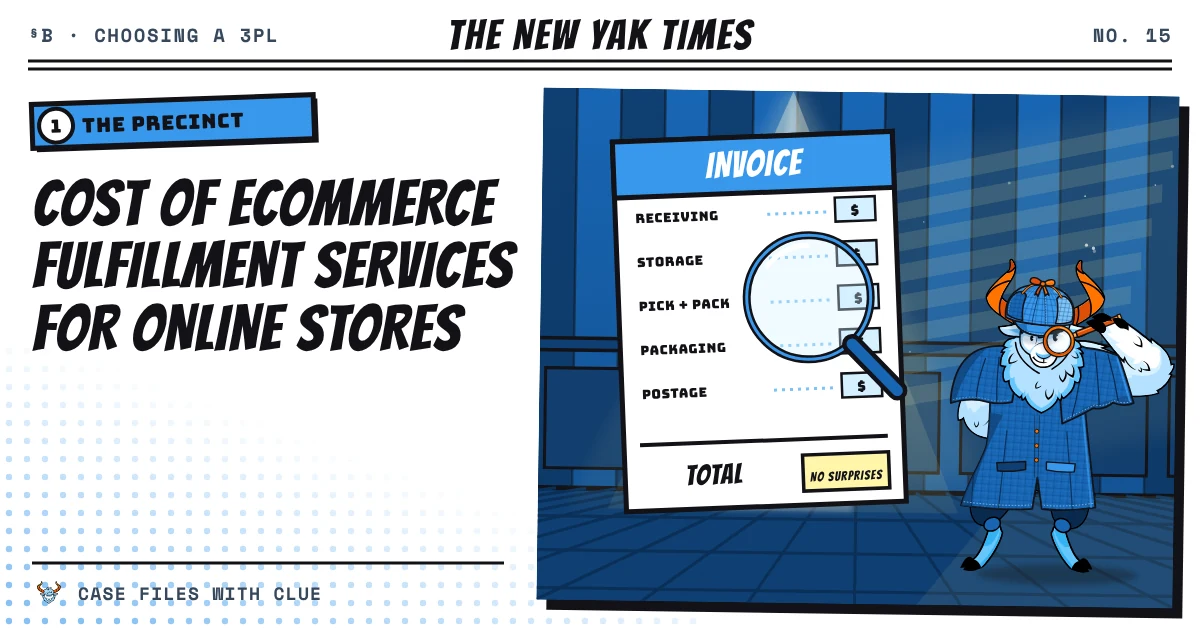
Definition: Everything you pay a 3PL to receive, store, pack and ship your orders: receiving, storage, pick and pack, packaging, postage, returns and any special projects.
At some point every growing online store hits a wall. Orders pile up, the garage is full and packing boxes eats the hours you should spend growing the business. That is when most founders start comparing fulfillment companies, and the first question is always the same: what is this going to cost?
Most 3PLs charge for the same handful of services. Once you know what each fee covers and how it is billed, quotes get much easier to compare. This guide breaks down every line on a typical fulfillment bill, the fees worth asking about up front and how to work out your real cost per order.
What fees do ecommerce fulfillment companies charge?
A fulfillment bill usually has six parts:
| Fee | What it covers | How it is usually billed |
|---|---|---|
| Receiving | Unloading and checking in your inventory | Per item, carton, pallet or container |
| Storage | Space for your inventory in the warehouse | Per bin, shelf, pallet or cubic foot |
| Pick and pack | Pulling each order from the shelf and packing it | Per order, plus a fee for each additional item |
| Packaging | Boxes, mailers, tape, dunnage and inserts | Per box or mailer by size; some 3PLs include tape and dunnage |
| Shipping | Postage for each package | Per label, based on weight, size and zone |
| Returns and special projects | Processing returns and custom work like relabeling or kitting | Per return; special projects by the hour |
How does pick and pack pricing work?
Pick and pack is the core fulfillment fee. Most 3PLs charge one rate for each order, which covers the first item, and a smaller fee for each additional item in the same order. So an order with three items is billed as one order plus two additional picks.
Rates usually drop as your monthly order volume grows. At PackYak, pick and pack runs $1.50 to $2.50 per order, plus custom pricing for high-volume shippers. You can estimate your own monthly cost with our fulfillment cost calculator.
How do 3PLs charge for storage and receiving?
Storage is billed by the space your inventory takes up: a small bin for each SKU, a shelf or a full pallet. Some warehouses bill by the cubic foot instead. The cheapest storage plan is simply not keeping more stock than you sell, so send in what you need for the next few weeks and reorder on a schedule.
Receiving covers unloading your freight and checking each item into inventory. It may be billed per item, per carton, per pallet or per container. Receiving goes faster, and costs less, when inventory arrives labeled and organized the way the warehouse expects. Ask for the 3PL's receiving guidelines before your first shipment. Here are ours.
What affects your shipping costs?
Postage is usually the biggest line on your bill. Every label is priced on four things:
- Weight: heavier packages cost more.
- Size: large, light packages may be billed by dimensional (DIM) weight instead of actual weight.
- Distance: carriers price by shipping zone, and every zone further away costs more.
- Carrier and service: ground, expedited and international services are priced differently.
A 3PL helps on two fronts. It ships enough volume to get discounted carrier rates, and a well-placed warehouse keeps more of your orders in lower zones. Check how far your orders travel on our USPS zone map, or read how multi-location fulfillment cuts zones.
What hidden fulfillment fees should you ask about?
Most surprise charges come from fees nobody asked about during the sales call. Before you sign, get a clear answer on each of these:
- Setup or onboarding fees to open your account.
- Contract length and what it costs to leave.
- Monthly account, integration or minimum fees.
- Packaging markups, and whether tape, labels and dunnage are included.
- Receiving surcharges for loose cartons, unlabeled items or floor-loaded containers.
- Peak season surcharges during the holidays.
- Returns processing and what happens to items that can't be resold.
- Special project rates for relabeling, kitting or fixing inventory that arrived wrong, and whether they confirm the cost before starting.
A good 3PL answers all of these in writing and sends an itemized invoice, so you can see exactly what you paid for.
How do you calculate your fulfillment cost per order?
Comparing rate cards line by line rarely tells you which 3PL is cheaper. Instead, price out one typical month with each provider:
- List your average monthly orders, items per order, number of SKUs and how much inventory you keep on hand.
- Add up pick and pack, storage, packaging and estimated postage for that month.
- Add your expected receiving and returns.
- Divide the total by your number of orders.
That cost per order is the number to compare. Then weigh it against what you get for it: speed, accuracy, support and how much of your own time it frees up. If you are still deciding whether to outsource at all, our guide to in-house vs 3PL fulfillment walks through that math.
How does PackYak price ecommerce fulfillment?
PackYak Fulfillment keeps pricing simple and visible:
- Pick and pack at $1.50 to $2.50 per order, plus custom pricing for high-volume shippers.
- Tape, dunnage and labels included at no extra cost.
- Itemized weekly billing, with no setup fees and no long-term contracts.
- Special projects confirmed before we start, so there are no surprise charges.
- Same-day fulfillment for orders placed by 12 PM and a 100% order accuracy guarantee.
See every rate on our pricing page, try the cost calculator, or get a free fulfillment quote and our team will build an exact, itemized quote around your products and order volume.
How much does ecommerce fulfillment cost?
It depends on your order volume, items per order, storage needs and shipping. Most 3PLs charge separately for receiving, storage, pick and pack, packaging, postage and returns. At PackYak, pick and pack runs $1.50 to $2.50 per order, plus custom pricing for high-volume shippers.
What is a pick and pack fee?
It is the fee for pulling an order’s items from the shelf and packing them. Most 3PLs charge per order, which covers the first item, plus a smaller fee for each additional item in the same order.
What hidden fees do 3PLs charge?
The usual surprises are setup fees, long contracts, monthly account or minimum fees, packaging markups, receiving surcharges, peak season fees and special project charges. Ask about each one in writing before you sign.
How do I compare 3PL quotes?
Price one typical month with each provider, including pick and pack, storage, packaging, postage, receiving and returns, then divide by your order count. Compare that cost per order alongside speed, accuracy and support.

Fulfillment, shipping and ecommerce know-how from the herd behind same-day fulfillment in Salt Lake City and Sunman. Filed by the district desk and checked by The Chief.
Meet the newsroom →