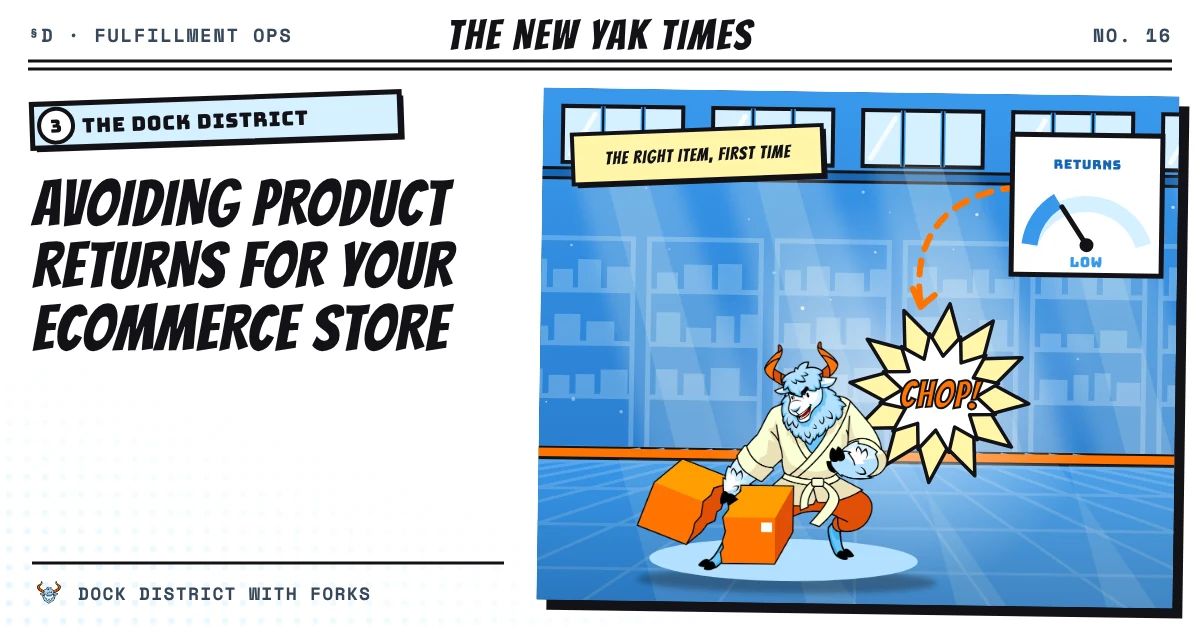
Definition: The share of orders customers send back. Divide the number of orders returned by the number of orders shipped over the same period.
Returns eat into margins twice: you lose the sale, and you pay to ship, check and restock the item. They also take up time you could spend growing your store. Online orders come back far more often than in-store purchases, because shoppers can't touch, try or test the product before they buy.
The good news is that many returns are preventable. This guide covers the most common reasons ecommerce orders come back and the fixes that cut each one.
Why do customers return ecommerce orders?
Most returns come from a handful of causes:
- The item arrived damaged. Products get dropped, crushed and stacked as they move through carrier networks.
- The wrong item or size arrived. A mis-pick in the warehouse, or a mix-up between similar products and variants.
- It looks different than expected. Photos, colors or descriptions didn't match the real product.
- It doesn't fit. A big driver for apparel and footwear.
- The customer changed their mind. Gifts, duplicate purchases and buyer's remorse.
You can't control every reason. But damage, wrong items and "not as described" are largely in your hands, and they are often the most expensive returns because the customer is unhappy too.
How can you reduce returns from damaged products?
Damage is mostly a packaging problem. Match the box to the product: a right-sized box stops items from sliding, while padding, void fill or paper wrap protects anything fragile. Liquids should be sealed in a bag so one leak doesn't ruin the order.
Fewer hand-offs help too. Shipping from a warehouse closer to your customer means fewer days in transit and fewer chances to get dropped. Use our USPS zone map to see how far your orders travel today.
How can you stop wrong-item returns?
Wrong-item returns almost always trace back to picking. They spike when order volume jumps and new or temporary staff start packing. The fix is a process where every item is scanned against the order before it is packed, so a wrong SKU or size gets caught at the packing station instead of by your customer.
If you already work with a 3PL and still see wrong items going out, that is a red flag. Ask whether every pick is scanned and whether they put an accuracy guarantee behind their work.
How do product pages affect your return rate?
Returns that start with "it looks different" begin on your product page. A few changes go a long way:
- Use real photos from several angles, including the product in use.
- Add a short video for anything with moving parts, texture or a finish.
- List exact dimensions, materials and what is in the box.
- Add size charts and fit notes for apparel and footwear.
- Answer common questions on the page, before the customer has to guess.
Why should you track the reasons behind every return?
You can't fix what you don't measure. Ask for a reason on every return, then review the data monthly by product and by reason. If one SKU keeps coming back as "damaged," change its packaging. If another comes back as "not as described," update its photos and copy. Tracking your fulfillment costs alongside returns shows how much each fix is worth.
How does PackYak help ecommerce brands reduce returns?
PackYak Fulfillment works on the returns you can prevent and handles the ones you can't:
- A 100% order accuracy guarantee: if we ever ship the wrong item, we waive the fulfillment fee on the reship.
- Packaging matched to your products, with our team recommending safer options for fragile items.
- Two warehouses in Salt Lake City, UT and Sunman, IN that put 98% of US ZIP codes within Zone 5, for shorter trips and fewer hand-offs.
- Returns processing starting at $2.50 per return, so returned items are handled for you.
- Same-day fulfillment for orders placed by 12 PM.
See all of our fulfillment services, or get a free fulfillment quote and our team will build an exact quote around your products and order volume.
What is a good ecommerce return rate?
It depends on the category. Apparel and footwear run much higher than most products. Compare your rate against your own history and track it by product and reason rather than chasing one benchmark.
How do I reduce returns from damaged products?
Use right-sized boxes, add padding or paper wrap around fragile items, seal liquids in bags and ship from a warehouse closer to your customers so packages spend less time in transit.
How can a 3PL help reduce returns?
A good 3PL scans every pick, matches packaging to your products and backs its work with an accuracy guarantee. PackYak offers a 100% order accuracy guarantee.
Does PackYak process returns?
Yes. PackYak handles returns processing starting at $2.50 per return.
Fulfillment, shipping and ecommerce know-how from the herd behind same-day fulfillment in Salt Lake City and Sunman. Filed by the district desk and checked by The Chief.
Meet the newsroom →