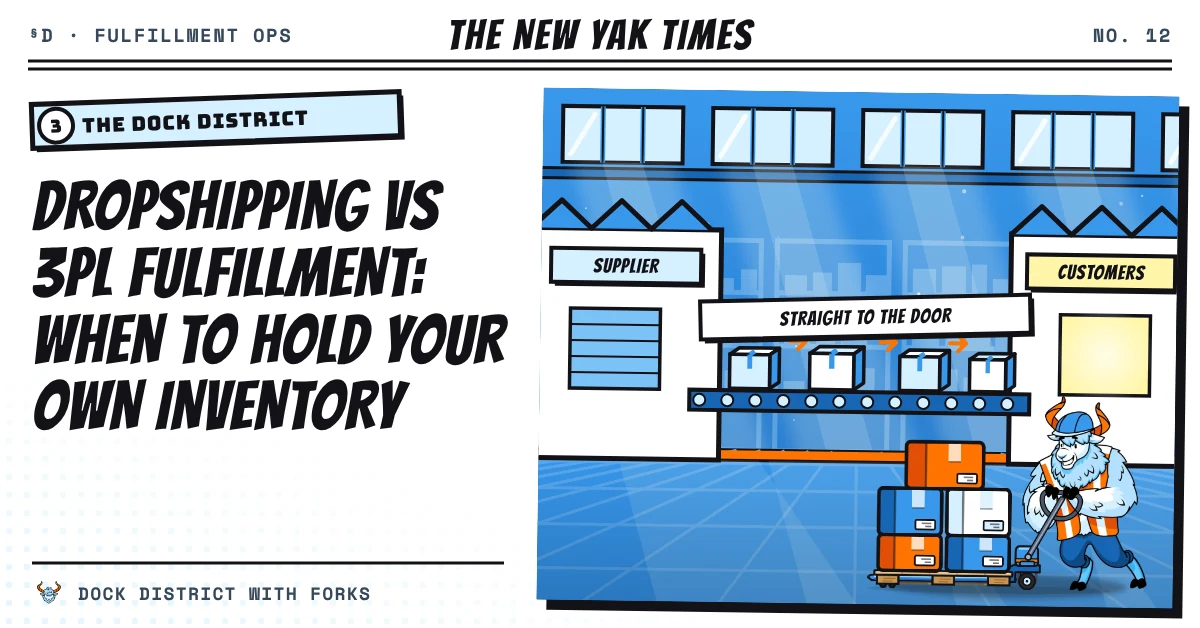
Definition: Selling products you never stock yourself. When a customer orders, your supplier ships the item straight to them.
Dropshipping is one of the easiest ways to start selling online. You don't buy inventory up front, you don't need storage space and you don't pack a single box. That's also its biggest weakness: you don't control the product, the packaging or how fast it arrives.
This guide explains how dropshipping works, where it tends to break down and how it compares with keeping your own inventory at a 3PL.
How does dropshipping work?
- You list a product from a supplier in your store.
- A customer buys it at your price.
- The order goes to the supplier, and you pay them their price.
- The supplier ships it directly to your customer.
- You keep the difference, minus fees and ad costs.
What are the common problems with dropshipping?
- Slow delivery. Suppliers that ship from overseas can take weeks to deliver, which leads to "where's my order?" emails, refunds and chargebacks.
- Thin margins. Per-item supplier prices and single-package shipping leave little room after ad spend.
- No quality control. You can't inspect what ships, so problems show up as returns and bad reviews.
- Generic packaging. Customers receive a plain mailer, not your brand.
- Split orders. A cart with items from two suppliers arrives in two packages at two different times.
- Stock surprises. Suppliers can run out without warning, leaving you with orders you can't fill.
Dropshipping vs 3PL fulfillment: how do they compare?
| Dropshipping | Your inventory at a 3PL | |
|---|---|---|
| Upfront cost | Little or none | You buy inventory in bulk |
| Cost per item | Higher supplier price per unit | Lower bulk price per unit |
| Delivery speed | Depends on the supplier, often slow | Ships from a US warehouse, usually 2 to 3 days |
| Quality control | None before it ships | Inventory is checked in at receiving |
| Branding | Supplier's packaging | Your boxes, inserts and packing instructions |
| Multi-item orders | Often split across suppliers | Packed together in one box |
| Best for | Testing products and ideas | Products that are proven sellers |
When should you move from dropshipping to holding inventory?
Dropshipping is a good way to test what sells. Once a product proves itself, the math often flips. Signs it's time to switch:
- A handful of products make up most of your sales.
- Slow delivery is driving refunds, chargebacks or bad reviews.
- You want branded packaging and a better unboxing.
- Your ad costs need a bigger margin to work.
Many brands run a hybrid for a while: proven best sellers live at a 3PL and ship fast, while new products are still tested through a supplier.
How do you make the switch?
- Pick your best sellers. Start with the products that move the most.
- Order in bulk. Ask your supplier or manufacturer for bulk pricing and have it shipped to your 3PL.
- Label it right. Follow the warehouse's receiving guidelines so check-in goes fast.
- Connect your store. Route orders for those products to the 3PL.
- Update delivery times. Show your faster shipping on product pages and at checkout.
How does PackYak help brands moving off dropshipping?
- Same-day fulfillment for orders placed by 12 PM, from Salt Lake City, UT and Sunman, IN.
- 2 to 3 day delivery to 99% of the US, with 98% of US ZIP codes within Zone 5.
- Your branding: custom boxes and inserts, added for $0.25 each.
- A 100% order accuracy guarantee on every order.
- Integrations with 120+ sales channels, set up within a day.
- A dedicated account manager in your own Slack channel.
Compare fulfillment options, check your costs in our fulfillment cost guide, or get a free fulfillment quote and our team will price your best sellers.
What is the difference between dropshipping and a 3PL?
With dropshipping, your supplier ships each order and you never hold stock. With a 3PL, you buy inventory in bulk and the 3PL stores, packs and ships it for you.
Is dropshipping still profitable?
It can be for testing products, but per-item supplier prices, single-package shipping and slow delivery often squeeze margins as you grow.
Can I use a 3PL and dropship at the same time?
Yes. Many brands keep best sellers at a 3PL for fast shipping and test new products through a dropshipping supplier.
Can PackYak use my branded packaging?
Yes. PackYak packs in your custom boxes and can add inserts for $0.25 each.
Fulfillment, shipping and ecommerce know-how from the herd behind same-day fulfillment in Salt Lake City and Sunman. Filed by the district desk and checked by The Chief.
Meet the newsroom →